Social-emotional development
Track social-emotional growth, set goals, and manage community agreements.
Last updated Oct 1, 2026
Social-emotional tracking
Montessori education places equal weight on social-emotional development and academic progress. FutureNerds gives you dedicated tools to track this dimension of each child's growth.
Getting there
The school-wide page for notes, goals, and community agreements is Social-emotional development. It is not in the top bar (Today, Children, Rooms, Calendar), and it is not one of the Classroom Tools.
On a child's Learning tab you can still read social-emotional notes that already exist. New note, New goal, and New agreement live on the school-wide page. The heading there shows notes this week, active goals, and community agreements.
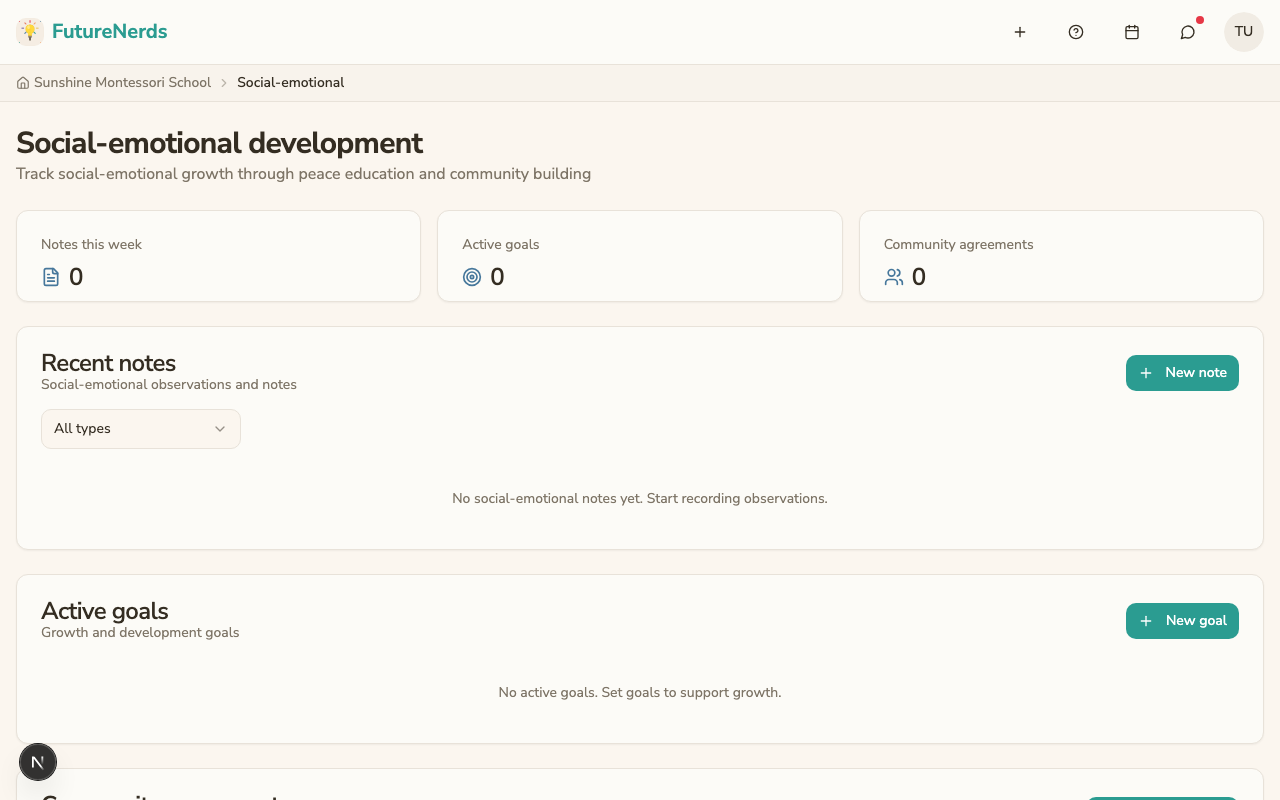
Social-emotional notes
Social-emotional notes are recorded through the observations system with the observation type set to "social-emotional." They capture moments like:
- A child resolving a conflict with a peer independently.
- A child showing empathy when another child is upset.
- Difficulty separating from a parent at drop-off.
- A breakthrough in self-regulation or focus.
Click New note. Pick Select classroom and Select child, choose a type (for example Grace & courtesy), write the note, and click Create. Notes are dated and linked to the child's profile. A child's Learning tab also shows social-emotional notes when any exist.
Growth goals
Growth goals are specific targets you set for individual children. Examples:
- "Practice using words to express frustration instead of hitting."
- "Greet classmates by name each morning."
- "Work independently for 15 minutes without seeking adult attention."
To create a goal:
- Click New goal.
- Select the child.
- Write the goal description.
- Save.
When the child achieves the goal, mark it as achieved. The goal moves from active to completed, and the date is recorded.
Community agreements
Community agreements are school-wide values or behavior expectations shared across classrooms. Examples: "We use gentle hands," "We take turns," "We clean up after ourselves."
Administrators or teachers can create agreements. They appear for everyone at the school.
Tips
- Record social-emotional notes as regularly as academic observations. Aim for at least one per child per month.
- Review growth goals during parent-teacher conferences.
- Involve children in creating community agreements at the start of the year.
Was This Helpful?